Published November 2, 2026 · Altvina Insights · 3 min read
Know Which Client Loss Would Change Your Plans
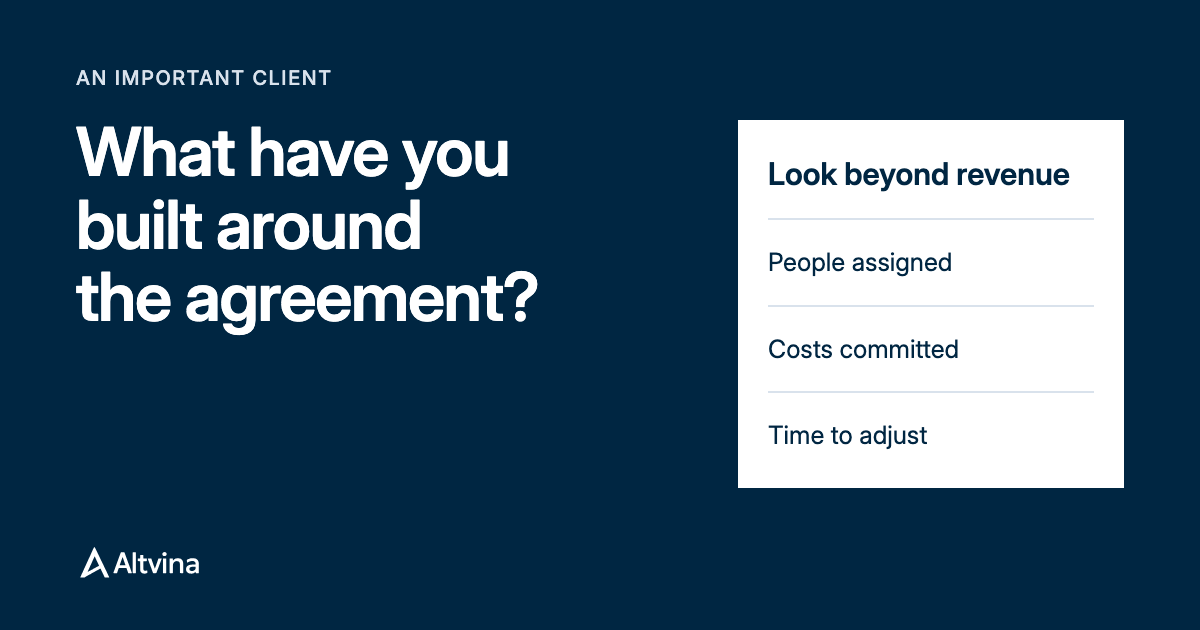
Look beyond a client’s share of revenue to the people, commitments and spending that would remain if the work ended.
You renew a large client agreement. It is also a useful moment to ask what would change if that work ended.
A strong client relationship can be worth keeping and investing in. Knowing how much depends on it gives you more room to make a considered decision about future commitments.
The Minneapolis Fed’s 2026 professional-services survey found that 79% of respondents reported rising input costs over the preceding four quarters. Only 44% reported raising their selling prices. These are regional respondent figures from the Ninth District. They do not measure client concentration. They show why revenue alone is an incomplete account of the room a service business has to adjust.
Use the same period for both sides of the comparison
Start with the revenue from the client and total business revenue over the same period. Look at the resulting share, then look at what it leaves out. A short project and a continuing agreement can produce similar sales totals while creating different future commitments.
Check the work already promised, the people assigned and any supplier or space commitments you made to serve it. Identify costs that could stop and costs that would continue. Bring your financial records to the person who helps you interpret them rather than guessing from the invoice total.
A percentage does not make the decision for you
This review does not set a threshold that declares a client too large. The right question is what losing the work would require your business to do, and how much time you would have to respond.
An agreement with clear notice arrangements is different from work that can stop without much warning. A client served by skills you can use elsewhere is different from a commitment that leaves expensive capacity with few alternatives.
Those differences belong beside the revenue share. They are not reasons to treat a good customer as a problem.
Use the answer while the relationship is healthy
Keeping the agreement while growing other client relationships may be the right decision. You might make future commitments more flexible, cross-train where appropriate or review renewal assumptions before expanding the team.
The business does not need to turn away useful work to demonstrate independence. It needs to understand what it has built around that work.
Start with the client whose departure would force the most immediate decisions. Establish what would remain, what could change and who would need to be involved. A plan makes that concentration percentage useful.
More from this week
This piece stands on its own. Here are this week's 5 pieces:
- Monday: Know Which Client Loss Would Change Your Plans (this post)
- Tuesday: Ask Before You Name a Professional Reference (coming Tuesday)
- Wednesday: A Client Complaint Needs a Way Back Into the Business (coming Wednesday)
- Thursday: A Career Break Does Not Need an Apology (coming Thursday)
- Friday: Agree How You Will Disagree With an Outside Partner (coming Friday)
Content and Accuracy Disclaimer
This article was drafted with AI assistance and reviewed by the Altvina team. We rigorously fact-check all content to ensure reliability.
Should you notice any inaccuracies or outdated information, please contact us so we can correct it. Your feedback helps us maintain high standards of accuracy and transparency.