Published September 3, 2026 · Altvina Insights · 5 min read
When the Tool Stack Gets Smaller: What It Does to a Role, Not Just a Budget
Cutting tools gets scored on the invoice, but the change lands on one person's recurring task. Here is a before and after comparison you can run on your own role this week, including the column almost nobody keeps: what got harder.
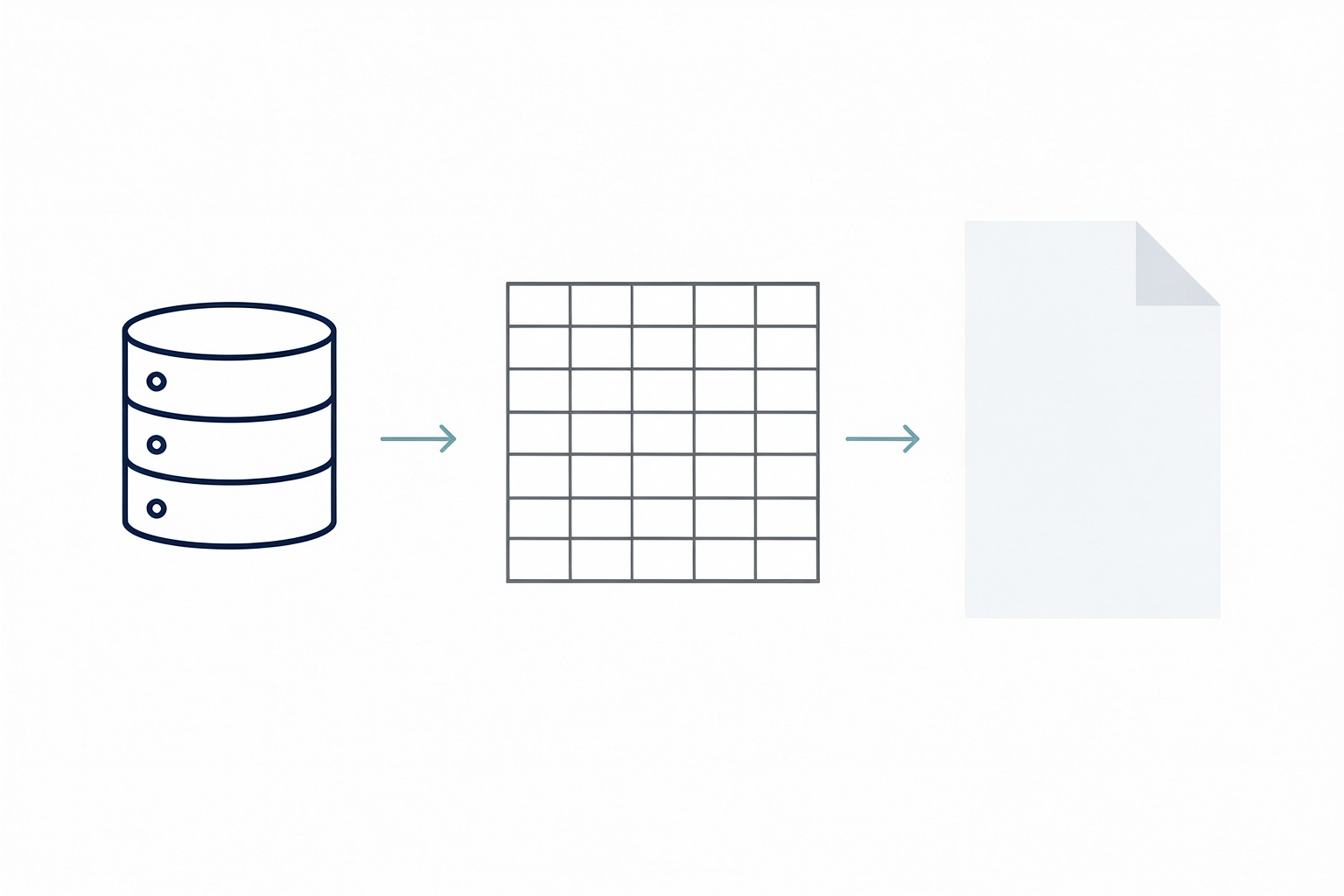
Open whatever tool you use to build your weekly client update, and count the stops between the raw numbers and the version that actually reaches the client: the system the figures live in, the spreadsheet where the columns get lined up, then the document template, because the reporting tool will not produce the layout anybody asked for.
Three stops is ordinary in a service firm. Four is common. Eventually the firm consolidates, one subscription replaces two or three, and the result gets written up as a line on an invoice: cancellations, a smaller monthly number. Whatever actually changed did not change on the invoice. It changed inside the hour somebody spends on that task every week.
The invoice is the wrong scoreboard
Savings get counted in one place. The change gets felt in another, by whoever holds the task. The distance between those two places is wider than most stack decisions allow for, and it is the reason consolidations get called wins long before anybody knows.
There is also a measurement trap worth knowing about before you trust anyone's read on how a tool is going, your own included.
In its February panel survey of US employed adults, Gallup found that 65% of employees at AI-adopting organizations say AI has improved their personal productivity and efficiency, regardless of how often they use it.
Frequency, in the same Gallup survey, reads much narrower: 13% of employees now say they use AI daily at work, with another 28% using it a few times a week or more.
So plenty of people report feeling better off, while a smaller group is actually in the tools most days. Neither figure tells an owner whether the work itself got better shaped, and neither does a smaller bill.
We hold this as judgment rather than as a finding: the only unit that answers the question is one recurring task, in one role, before and after.
A comparison you can do on one task this week
It costs about an hour spread over a few days. No budget authority required, and your own role will do fine.
Pick the task
Something you do at least weekly, and something you can say out loud as a verb phrase: "build the weekly client update", not "reporting". Last condition, and it matters: somebody waits on the output, even if that somebody is your own Friday self.
Write down the before path
List, in order, every tool you touched to finish that task in the old setup. Then add two counts.
Touches: the number of times you moved information by hand from one place to another. Waits: the number of points where you stopped and needed another person before you could carry on.
Write down the after path
Same task, current setup, same two counts. Then time one real run against an actual clock. Estimating will not do here, because memory rounds in the direction of whatever you already believe about the change.
Put a number on what got faster
One number is enough: minutes on the clock, touches removed, or days of turnaround. "Feels smoother" does not survive contact with an owner asking whether the consolidation was worth the money.
Keep the column almost nobody keeps
Write down what got harder, or what quietly stopped happening. That column is the reason the hour is worth spending.
One pattern is worth hunting on purpose because it turns up so often. A two-tool path usually has an accidental review step buried inside it. Copying numbers by hand is slow, and the copying is also a look. Somebody spots the figure that is obviously wrong on the way past. Take out the copying and the look goes with it, and nothing in the new setup was designed to replace it.
Other candidates worth checking: a record that existed only because the old tool kept its own copy, a downstream person who used to receive a by-product of your task and now receives nothing, a fallback that held up because two systems were rarely broken on the same morning.
The operators we bring in on consolidation work tend to open with the same question, and it is never about features: what else was living off that tool's output? Almost nobody has that written down until the week it breaks.
What to do with the two columns
Thresholds we use, not laws of nature.
When nothing in the faster column can be stated as a number after two weeks, the change was a swap rather than a consolidation. Worth saying plainly to whoever signed for it, because the next purchase will get argued from the same assumption.
Anything in the harder column that touches a person outside your own role gets written down this week and sent to one named person. Undocumented dependencies do not stay quiet. They pick their moment, usually a Friday.
Where both columns are entirely about you, fix the harder one with a habit or a calendar reminder and get on with your week. Not everything needs escalating.
Why this matters from where you sit
Most writing about tool spend is addressed to the person holding the card. The person who actually knows whether the stack change worked is usually the one doing the task, and they tend to get asked neither before the decision nor after it.
Two counts and a clock reading beat an honest shrug when the question finally arrives, and in our experience it arrives at renewal, with about a day's notice.
When nobody above you is thinking about the shape of the work
An aside, and the exercise above stands without it. A fair number of the people carrying this are not owners and have nobody above them redesigning anything. We do some of this work one to one, with individuals rather than firms, and anyone who wants a mentoring conversation about navigating it from where they sit can start at our individual services page.
Either way, the one thing to take from this: time a single run of one recurring task against a real clock this week, and write down the one thing that got harder. Next month's invoice will show a smaller number whether or not anybody checked.
More from this week
This piece stands on its own. Here are this week's 5 pieces:
- Monday: The AI Waste Audit a Small Firm Can Run in an Afternoon
- Tuesday: One Redesigned Workflow Beats the Next Three Tools
- Wednesday: The One Question to Ask Before Your Next AI Purchase
- Thursday: When the Tool Stack Gets Smaller: What It Does to a Role, Not Just a Budget (this post)
- Friday: Why Cash Catches Up to Growth Later Than Founders Expect
Content and Accuracy Disclaimer
This article was drafted with AI assistance and reviewed by the Altvina team. We rigorously fact-check all content to ensure reliability.
Should you notice any inaccuracies or outdated information, please contact us so we can correct it. Your feedback helps us maintain high standards of accuracy and transparency.