Published June 23, 2026 · Altvina Insights · 4 min read
The Line You Copied From January
The most honest sentence in your H2 plan is the one you carried over unchanged.
Open your H2 plan, or the draft of it, and look for one specific thing.
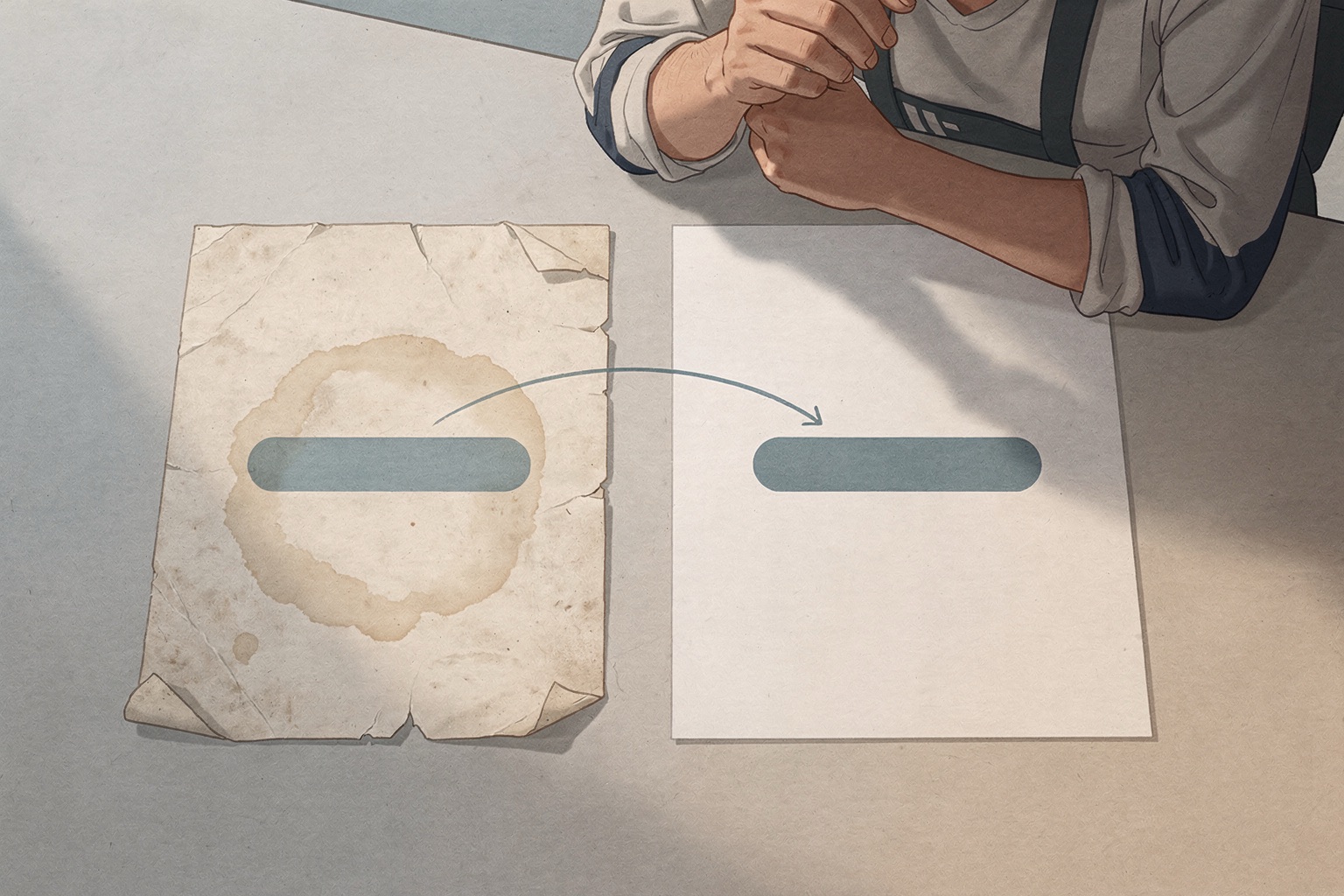
Odds are there is a line in there you copied from January. Not adapted. Not rescoped. Copied. The same commitment, in roughly the same words, now wearing a Q3 date instead of a Q1 one. Launch the new service line. Hire the delivery lead. Get the founder out of day-to-day project review.
Most plans have at least one. Many have several. Yesterday we argued that the mid-year ritual scores outcomes while the operating machine goes unexamined. Today is about the narrowest, most concrete place that shows up: this one line.
The most honest sentence in the plan
We mean this without irony. The line you copied from January is the most honest sentence in your H2 plan.
Every other line is a fresh guess. The copied line has data behind it. It is the one commitment that has already been tested against your actual operation, for six full months, and the result is in: it did not happen.
That makes it less like a goal and more like a record. It marks the exact spot where the plan met the machine and the machine won. Nothing else in the document tells you that much, that plainly.
What the line actually records
It is worth being precise about what the copied line is evidence of, because the natural reading is too kind.
The natural reading says: we did not get to it. Too busy, wrong half, bad timing. Under that reading, carrying the line forward is reasonable. The intention was sound, the calendar was not.
But a commitment that survived six months of being intended and zero months of being done is telling you something structural. Something in the operation absorbed it. Client work outranked it every single week. It needed a decision that only one person could make, and that person was the busiest one in the firm. It required capacity that the plan assumed and the calendar never produced.
Whatever that something is, it is still there. The line got a new page. Whatever stopped it never went anywhere.
New dates are not a new theory
This is the assumption inside every copied line: that new dates change outcomes.
Stated that baldly, almost nobody would defend it. Yet that is the full theory of the carried-over commitment. Same goal, same operation, same constraints, different quarter. The plan is betting that H2 will differ from H1 without containing any account of why.
Sometimes the bet is fine. Circumstances do change. A big engagement ends, a hire starts, a busy season passes. If you can point to the specific thing that is different, the copied line has earned its place.
But if the honest answer is that nothing in particular has changed except the date, then the line is not a plan. It is a hope with formatting.
One question, asked early
There is a useful question hiding under all of this, and it is worth asking now, before the rest of the planning gets done.
Which H2 commitment shares a root cause with an H1 miss?
Notice what the question does. It does not ask whether you tried hard enough, and it does not ask you to relitigate the half. It asks whether the new promise and the old miss are drawing from the same well. If the service launch slipped in H1 because delivery consumed every spare hour, and the H2 plan promises the launch plus a bigger delivery load, those two lines share a root cause, and one of them is going to lose again.
The copied line is the fastest way in. Take it, name what actually stopped it, then scan the rest of the plan for every other line that depends on that same thing being different. That cluster is where your H2 risk lives.
This question is one of five. On Wednesday we will publish the full set, a short load test you can run against a finished H2 plan in about fifteen minutes. Today, this one is enough.
One thing to try this week
Find your copied line. If you have one, you can probably name it in seconds. The small wince that comes with it is normal.
Then write one paragraph underneath it answering a single question: what, specifically, stopped this in H1? Not the polite version. The mechanical one. What absorbed the time, who the decision waited on, which work always outranked it.
Then look at the paragraph and ask whether anything in it will be different in H2. If yes, name the difference in the plan itself, so the line finally carries its own theory of why this time is not last time. If no, change the line. Shrink it, resequence it, or remove it honestly rather than re-promising it.
To be clear about the target: this is an audit of the plan, not of you. The copied line is not a verdict on your discipline. It is the plan's most honest sentence. Plan around it.
More from this week
This piece stands on its own. This week's 5 pieces all look at Load-Test the Plan. Then Look at the Price.:
- Monday: Your H2 Plan Is a Forecast of Your Bottleneck
- Tuesday: The Line You Copied From January (this post)
- Wednesday: The 15-Minute H2 Load Test
- Thursday: The Workflow Is Not Broken. It Is Executing the Price.
- Friday: Utilization Is High Because Pricing Is Broken
Keep reading
Bring the work as it stands
If the priority is already clear, Altvina can help shape a scoped engagement around it. If the symptoms are clear but the right intervention is not, the Blueprint provides diagnosis, priorities, and a sequenced roadmap.
A 20-minute Fit Call is the simplest place to determine whether Altvina can help and which path makes sense.
Content and Accuracy Disclaimer
This article was drafted with AI assistance and reviewed by the Altvina team. We rigorously fact-check all content to ensure reliability.
Should you notice any inaccuracies or outdated information, please contact us so we can correct it. Your feedback helps us maintain high standards of accuracy and transparency.