Published July 23, 2026 · Altvina Insights · 5 min read
The Sentences We Threw Away
We got our firm's biggest problem down to one plain sentence. These are the drafts that did not make it, and the test each one failed.
The short version: Yesterday we named the one problem holding our firm back, in a single plain sentence. Today we show the sentences we threw away on the way there, and the test each one failed. Bad examples taught us the standard faster than the rules did.
"The founders are the bottleneck."
We wrote that sentence while diagnosing our own firm.
It sounds like an answer. For a firm run by two people, it is the answer most readers would expect.
We threw it away.
If today is your first visit: this week we are running a public checkup on our own firm. Yesterday we published the result: a one-page memo that names our constraint. A constraint is the one problem that keeps the other problems stuck. The memo says ours in a single plain sentence.
That sentence was not our first try. Plain sentences take rewrites. And every rewrite happened because a draft failed one of five tests.
Today we show the tests, and the real drafts that failed them.
The five tests a problem sentence must pass
Each test is a question anyone can ask about a sentence:
- Does it name a mechanism, not a mood? A mechanism is something that happens: this work waits on that person. A mood is how the firm feels: busy, stretched, behind.
- Could a stranger check it? Could someone look at a calendar, an inbox, or a list of clients and see whether the sentence is true?
- Does it sting a little? A true sentence about your own firm is a bit uncomfortable. A sentence that fits every firm points at none.
- Is it a constraint, not a complaint? A complaint says what hurts. A constraint says what is stuck and keeping the rest stuck.
- Does it say what to measure? If the sentence is right, it should tell you what to count next.
Four out of five sends the sentence back for a rewrite.
The wastebasket
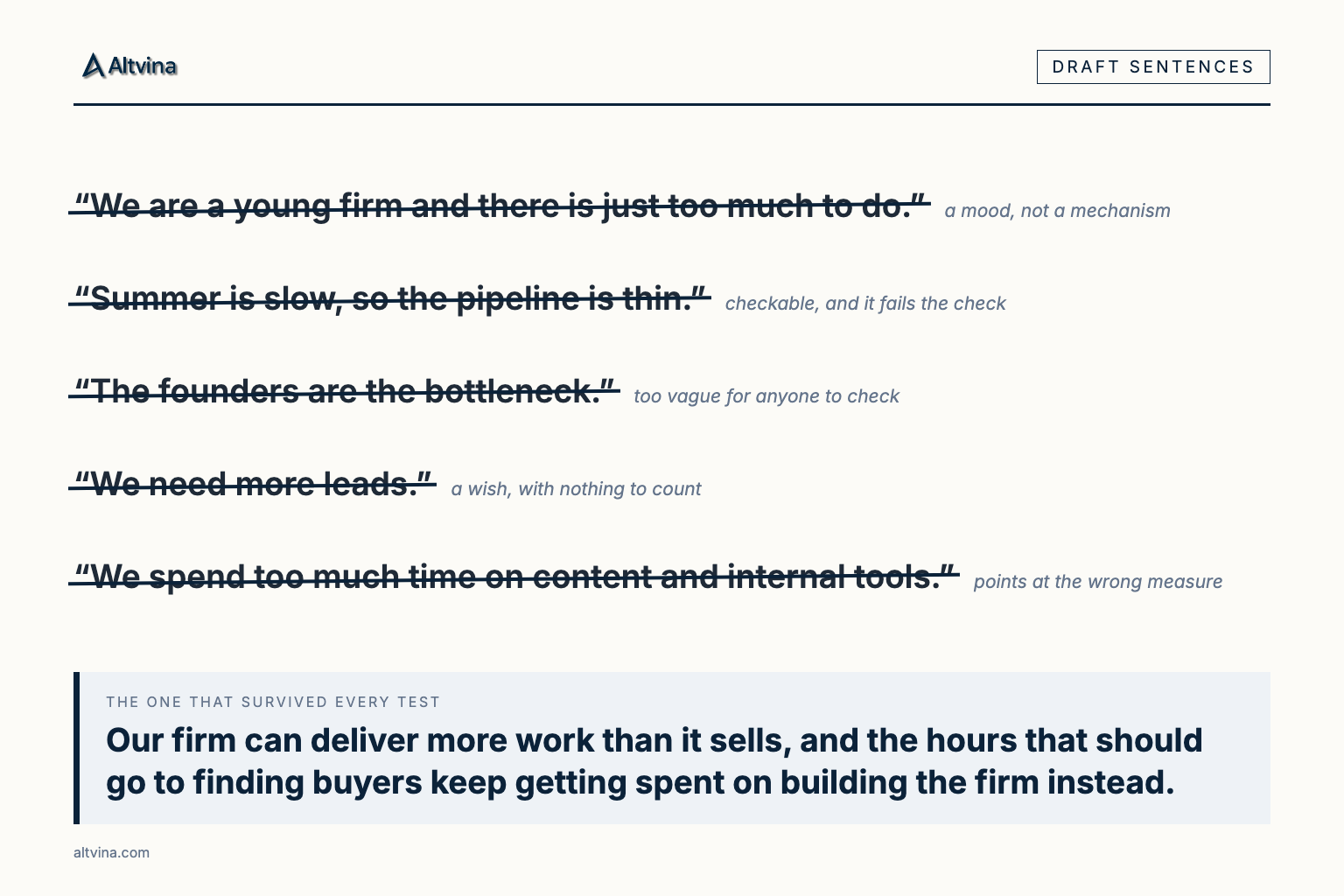
"We are a young firm and there is just too much to do."
It failed test one. The whole sentence is a mood. It says the firm is buried without saying what happens, or where, or why, so any new firm could say it word for word and nobody could check it. It was also the most comfortable sentence in the pile.
"Summer is slow, so the pipeline is thin."
This one failed test two, in an unusual way. The sentence can be checked. So we checked it. The one thing we control is our own selling hours, and we had not used all of those before blaming July. Checkable is not the same as checked. This draft felt measured long before anyone measured it, which is what made it dangerous, and it failed the moment we looked.
"The founders are the bottleneck."
The sentence this piece opened with. It failed test three: it does not sting, because it is not specific. It never says which work waits on which person, or for how long. There is nothing in it a stranger could check. It also borrows its shape from last week, when we practiced this checkup on an example firm whose answer really was one overloaded person. It felt true mostly because we had just watched it be true for that firm.
"We need more leads."
A wish. It says nothing about why leads do not arrive or what to count, and it made the fastest trip to the trash all week.
"We spend too much time on content and internal tools."
The nearest miss. It failed test five: it points at the wrong measure. It says which activity to cut, but it never says what those hours were supposed to buy instead, so cutting the activity could feel like progress while leaving the real problem exactly where it was. Hard to argue with, and still wrong: what it describes is a symptom, and the constraint sits one level down. It is also the least comfortable one for us, because it points at hours spent on content, and you are reading some of those hours right now.
The sentence that passed
Yesterday's memo carries the one that survived:
"Our firm can deliver more work than it sells, and the hours that should go to finding buyers keep getting spent on building the firm instead."
Yesterday's piece makes the case for it. Today it has one job: showing what a pass looks like.
- It names a mechanism: hours going to one kind of work instead of another.
- A stranger could check it: a calendar shows where the hours went.
- It stings a little: it says our own selling hours are going somewhere else.
- It is a constraint: the stuck hours it names are what keep everything else stuck.
- It says what to measure: the hours that actually go to finding buyers, each week.
Every sentence in the wastebasket is more comfortable than this one. The difference is that this one can lose: anyone can pull a calendar, count the hours that go to finding buyers, and see whether it holds.
These five tests also do the grading behind the door we opened last Friday. The offer is simple: a business owner sends one sentence about where their firm is stuck, through our site's contact form, a comment, or a direct message. A straight read on that sentence goes back. No pitch comes with it.
The tests are not ours in any way that matters. If you have written a sentence like this about your own firm, the same five questions grade it. Swap our nouns for yours.
One warning from our own wastebasket. If your sentence ends in a tool or a hire, it fails test one before you finish writing it, because a tool or a hire is an answer, and test one wants the mechanism underneath it. Buying the answer before you can name the mechanism usually means paying full price to fix the wrong thing.
The first test your sentence fails shows you what to fix. Once it passes all five, the sentence itself tells you what to count next.
More from this week
This piece stands on its own. This week's 5 pieces all look at Diagnosing Our Own Firm:
- Monday: The Rules We Set Before Diagnosing Our Own Firm
- Tuesday: Where Work Stops at a Two-Person Firm
- Wednesday: Our Constraint, in One Plain Sentence
- Thursday: The Sentences We Threw Away (this post)
- Friday: The Fix We Chose, Priced
Content and Accuracy Disclaimer
This article was drafted with AI assistance and reviewed by the Altvina team. We rigorously fact-check all content to ensure reliability.
Should you notice any inaccuracies or outdated information, please contact us so we can correct it. Your feedback helps us maintain high standards of accuracy and transparency.