Published November 6, 2026 · Altvina Insights · 3 min read
Agree How You Will Disagree With an Outside Partner
Before work becomes contentious, decide how concerns will be heard, which decisions belong to whom and how unresolved questions will be handled.
You ask an outside partner for expertise. There should be room for that person to tell you when they think the proposed approach will fail.
There should also be room for you to question the advice. Expertise does not remove your responsibility for the business. A useful working relationship needs a way to handle both kinds of challenge.
Make the concern clear enough to discuss
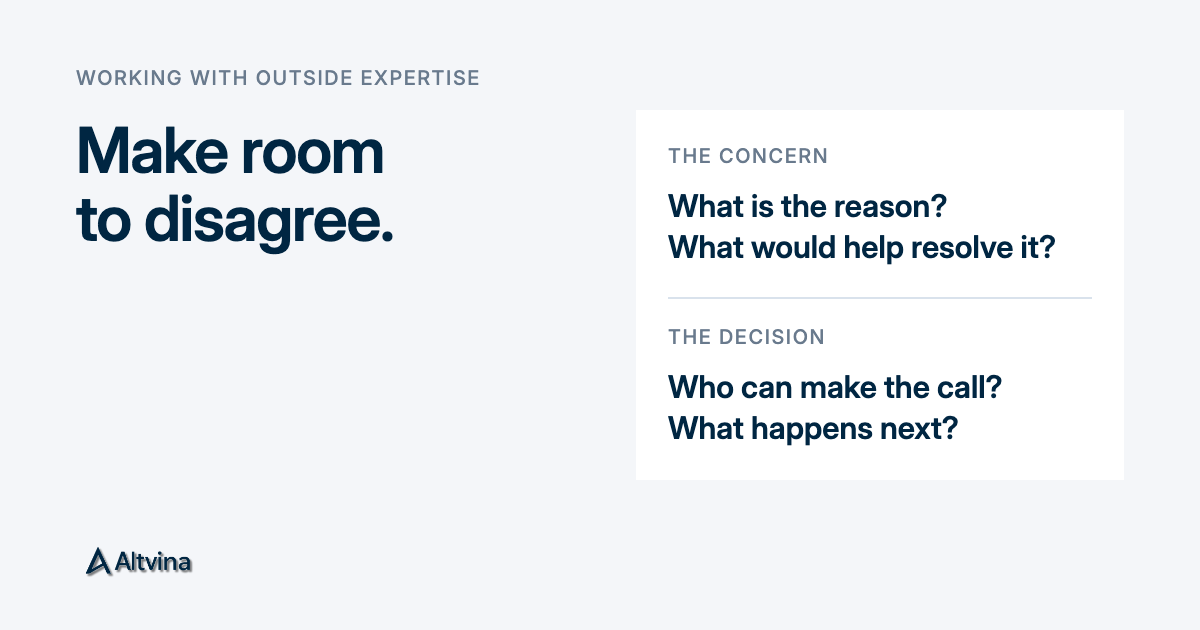
Ask for the reason behind a concern and what evidence would help resolve it. Is the disagreement about the intended result, the available resources or the way the work should be done? A broad statement that the approach is wrong is difficult to act on.
Write down the point you need to decide. Give the other person a chance to correct that account before treating it as their position. That check can reveal a disagreement that is smaller, or more important, than it first sounded.
Keep decision rights visible
Agree which decisions the partner can make within the work and which need your approval. Confirm where specialist or professional obligations place limits on either person’s discretion. A working agreement cannot make those obligations disappear.
If the disagreement remains, know who will make the business decision, what information they need and whether the affected work should pause. Do not let an unresolved issue travel into a commitment simply because the rest of the project is busy.
A challenge can be useful without becoming a contest
The answer may be to keep the approach, change it, seek another qualified view or stop that part of the work. Record the decision and its reason so people can act on the same understanding.
Trust does not require every concern to be accepted. Raising a concern should be part of the relationship rather than a breach of it.
We would like to hear how business owners and specialists make this work. What agreement has helped you disagree without leaving the work stuck? We are interested in the practical arrangements, including the ones you tried and decided not to keep.
More from this week
This piece stands on its own. Here are this week's 5 pieces:
- Monday: Know Which Client Loss Would Change Your Plans
- Tuesday: Ask Before You Name a Professional Reference
- Wednesday: A Client Complaint Needs a Way Back Into the Business
- Thursday: A Career Break Does Not Need an Apology
- Friday: Agree How You Will Disagree With an Outside Partner (this post)
Content and Accuracy Disclaimer
This article was drafted with AI assistance and reviewed by the Altvina team. We rigorously fact-check all content to ensure reliability.
Should you notice any inaccuracies or outdated information, please contact us so we can correct it. Your feedback helps us maintain high standards of accuracy and transparency.